PALMYRA

  • Trailer
  • Photos
  • Team
  • Press
  • Reviews
  • Contact
  • Book
  • DEENRU
  • IMDb★9.4/10Rate

Palmyra (2016) — Film Review
kino-zeit.de | Von : Daniel Kirschbaum | 25. Juli 2018
#kinozeitde#Palmyra#Essayfilm#HansPuttnies#Dokumentarfilm#Kulturerbe

Review by Bianka Piringer | kino-zeit.de | July 25, 2018

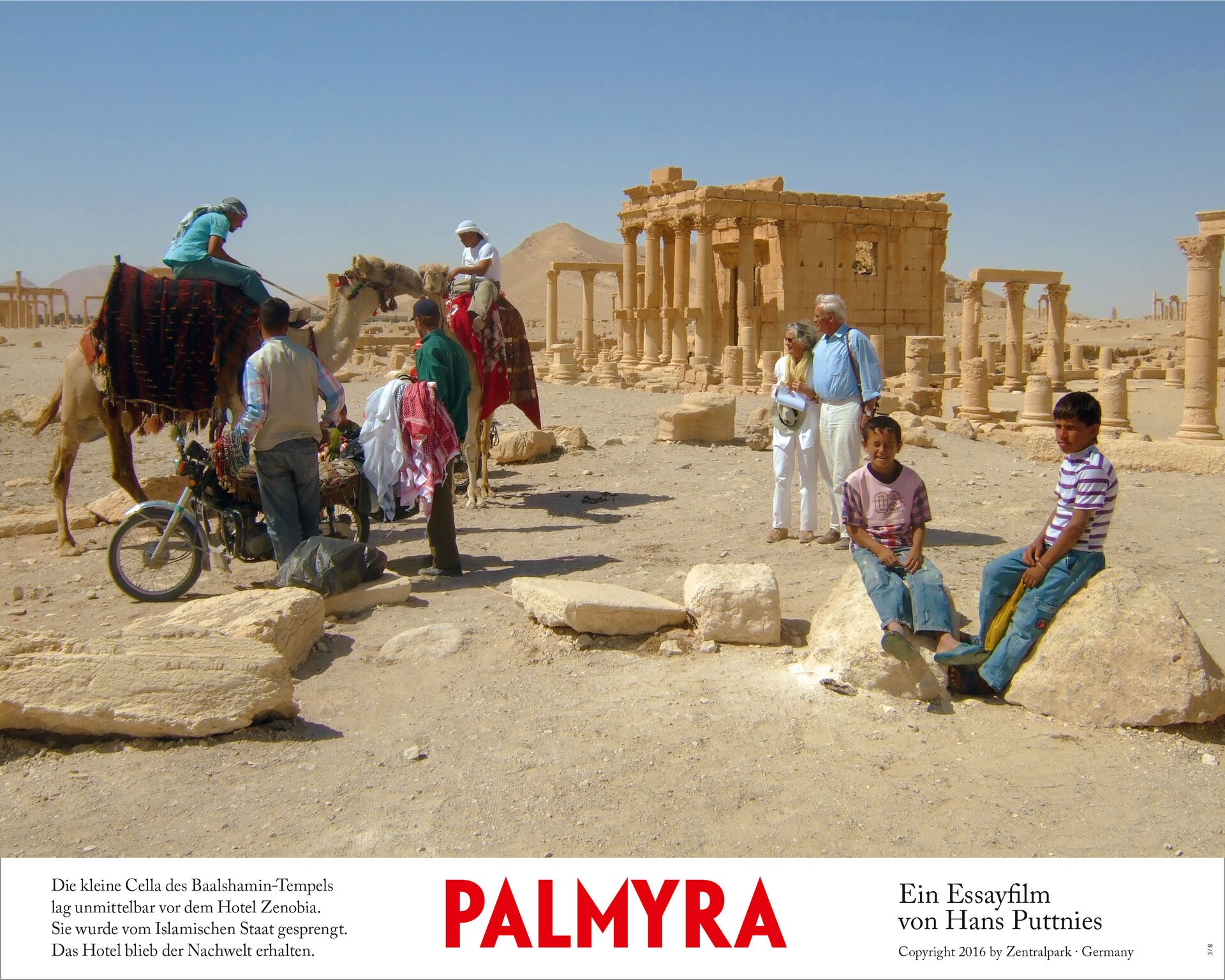
Documentary filmmaker Hans Puttnies visited the ancient city of Palmyra in Syria with his camera in 2008. His essay film, completed in 2017, not only seeks to preserve the former appearance of the ruined city, but also critically questions the Western concept of culture.

Western interest in Palmyra, which once belonged to the Roman Empire, began in the 18th century with research expeditions. To facilitate systematic excavations for European museums, the inhabitants of Palmyra were relocated and the nearby town of Tadmor was founded. Puttnies criticizes the one-sided cognitive interest of Western researchers, focused on the intellectual reconstruction of antiquity.

The film shows that early inhabitants knew around 60 deities, yet apart from column inscriptions hardly any written records of daily life exist. The beautiful gateways do not reveal that Christians and later Muslims built their places of worship in the temples, nor do they tell of people who lived here without leaving historical traces.

During filming, Puttnies met the 15-year-old Bedouin Mohamad, a souvenir vendor. According to the press kit, he was later tortured by ISIS but escaped to Denmark.

The film uses ISIS propaganda videos that document both the destruction of Palmyra and lethal atrocities. Puttnies largely dispenses with original sound and relies instead on his contemplative voice-over commentary and experimental electronic music. This formal choice creates distance from the object and signals that the gaze itself estranges it.

However, the film does not completely break with the Western tradition. People are rarely placed at the center; aside from Mohamad, no local resident speaks. Puttnies talks about people, not with them, and so the chance to show the place as a living environment is missed. By emphasizing the essayistic, he points to the subjectivity and partiality of his contemplative cultural-historical journey.

In the summer of 2015, the terror militias of the „Islamic State“ destroyed the famous temples of Palmyra. The Assad regime then bombed the modern town of Tadmor next door and turned the families that had lived off the monuments into refugees in Europe.

→ to the article (kino-zeit.de)

25 Juli 2018
← Vorheriger Beitrag
Film im Gespräch: Ehemaliger Darmstädter Medienkultur-Professor Hans Puttnies bringt „Palmyra“ ins Rex
Nächster Beitrag →
Palmyra - Filmkritik

Recent Posts

  • War is a Dance Floor
  • Palmyra, the Soul of the Syrian Nation
  • Palmyra — A Review
  • Palmyra: The Dark Side of the Oasis
  • Palmyra — A European Myth

Archive

  • September 2018
  • August 2018
  • Juli 2018
  • April 2017
  • März 2017
  • Februar 2017
facebook

Kontakt

Produktion

info(at)palmyrafilm.de
zentralpark.de

Write to Us

Wird gesendet...
Bitte füllen Sie alle Felder aus
Bitte geben Sie eine gültige E-Mail-Adresse ein
Beim Senden ist ein Fehler aufgetreten
Your Message wurde gesendet
Copyright © ZENTRALPARK 2026 IMPRESSUM | Produktion info(at)palmyrafilm.de | zentralpark.de
This website uses technically required cookies (cookie consent, WordPress session) as well as Vimeo cookies when playing embedded videos. Accept Learn more
Privacy & Cookies Policy

Privacy Overview

This website uses cookies to improve your experience while you navigate through the website. Out of these, the cookies that are categorized as necessary are stored on your browser as they are essential for the working of basic functionalities of the website. We also use third-party cookies that help us analyze and understand how you use this website. These cookies will be stored in your browser only with your consent. You also have the option to opt-out of these cookies. But opting out of some of these cookies may affect your browsing experience.
Necessary
immer aktiv
Necessary cookies are absolutely essential for the website to function properly. This category only includes cookies that ensures basic functionalities and security features of the website. These cookies do not store any personal information.
Non-necessary
Any cookies that may not be particularly necessary for the website to function and is used specifically to collect user personal data via analytics, ads, other embedded contents are termed as non-necessary cookies. It is mandatory to procure user consent prior to running these cookies on your website.
SPEICHERN & AKZEPTIEREN