On the Trail of the Stones
Review by Felix Bartels | Neues Deutschland | September 3, 2018
The work, the director honestly admits, is an essay film, for the author's words take up a great deal of space. The genre label seems to forestall possible objections, since documentary filmmakers today are generally expected to retreat behind what they show. This objectivity is itself merely an appearance, however, since no arrangement exists without intention — and fittingly, that is precisely what "Palmyra" is about: how much construction and falsification lie in the production of the authentic?
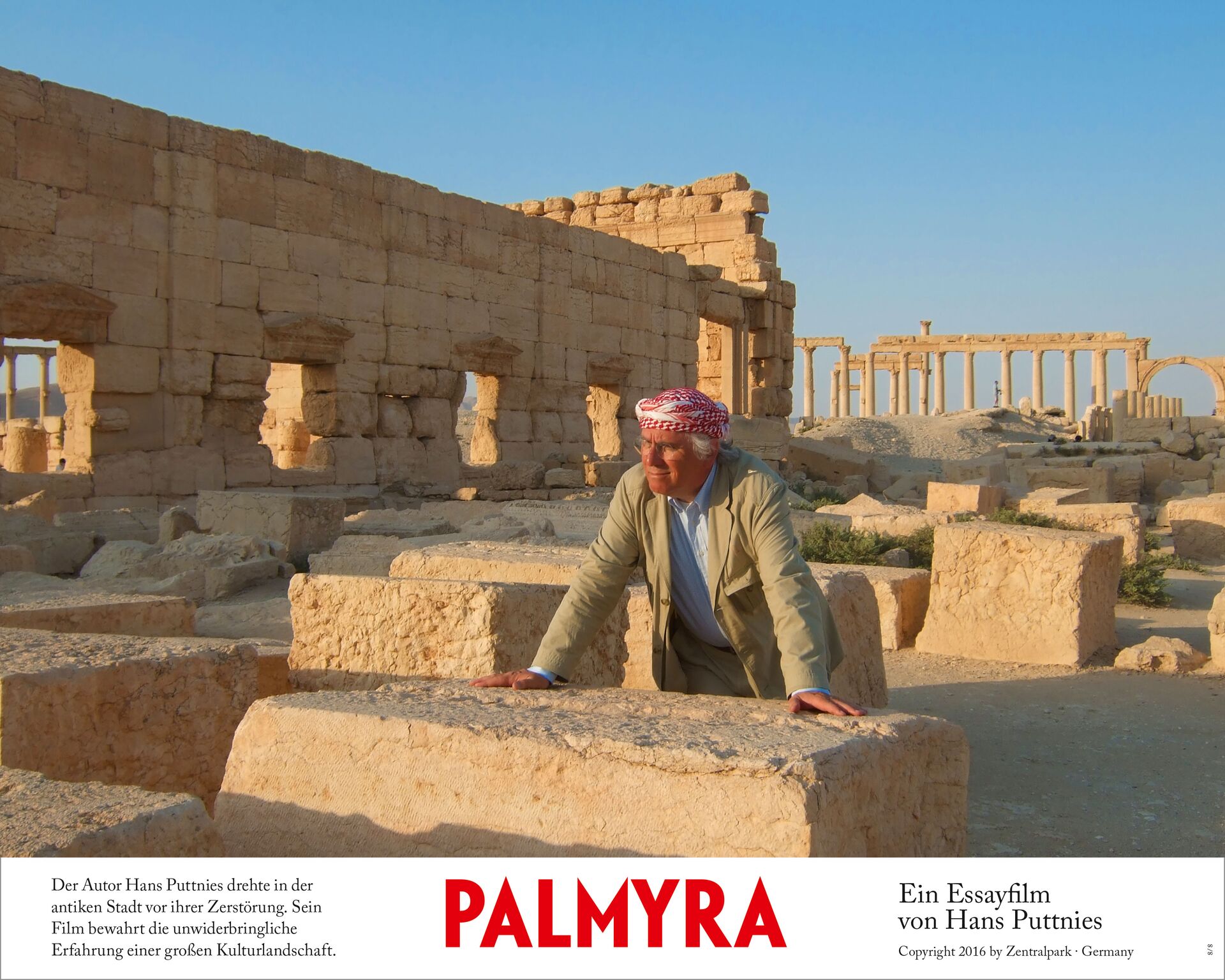
It is about stones, the ruins of Palmyra, parts of which were destroyed in 2015 by troops of the Islamic State. Documentary filmmaker Hans Puttnies seeks to show the destruction of the tomb sites as a stage in a much longer process of annihilation. He filmed the ruins a few years before their destruction. Through the civil war, a different film emerged from the existing material. Historiography was overtaken by history.
Like almost all archaeology, the efforts at Palmyra stood in the context of colonial politics. The preservation of the ruins was tied to the destruction of "grown Arab history" — the demolition of surrounding buildings and the relocation of all local inhabitants in 1930.
The film deconstructs the idea of World Heritage by showing that the posture of preservation is equally founded on destruction; the idea of an ancient cultural artifact proves to be abstract and constructed retroactively. The murder of Syrian archaeologist Khaled Asaad is critically examined without being glorified.
The people are silent like the stones, or they speak and one does not hear what they say. For above everything lies the music or the voice of the author. For a long time this essay feels like a silent film, with sound and image running separately. The final sequence belongs entirely to one of the people who live there and who are directly affected.
Germany 2017 | Director and screenplay: Hans Puttnies | 90 min.